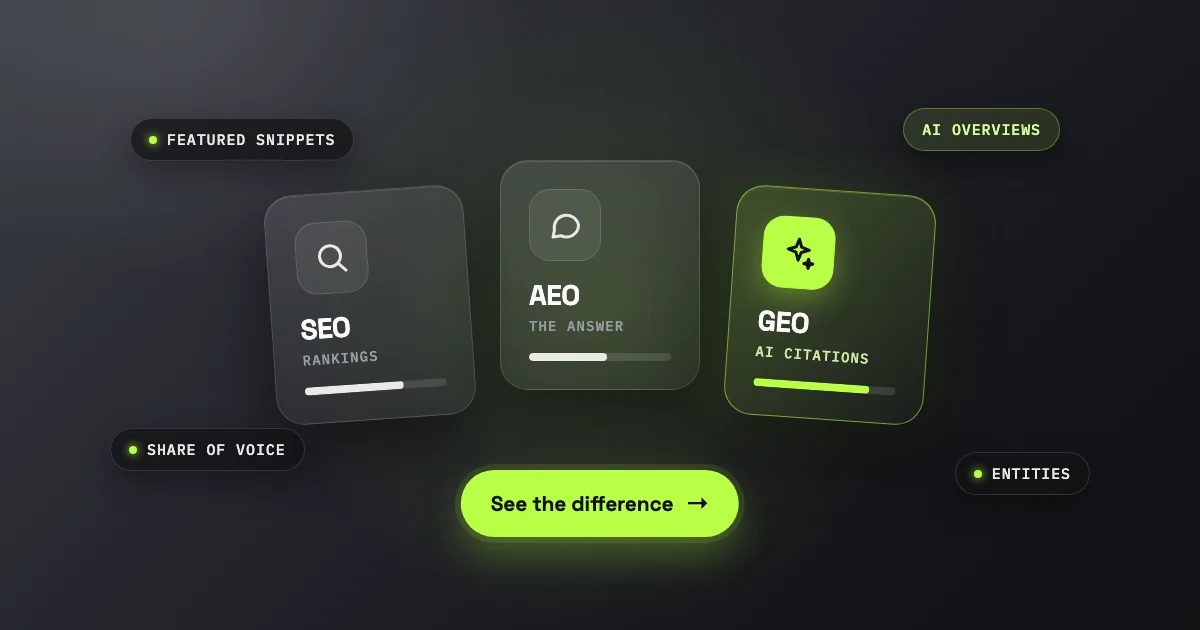
SEO (search engine optimization) gets your pages ranked in search results. AEO (answer engine optimization) gets your content chosen as the direct answer to a question, in a featured snippet, a voice assistant or an AI summary. GEO (generative engine optimization) gets your brand mentioned and cited inside answers written by AI tools such as ChatGPT, Perplexity, Gemini and Google AI Overviews. They aren't competing strategies. SEO is the foundation, and AEO and GEO are layers on top of it.
- SEO earns rankings and clicks. AEO earns the answer slot. GEO earns mentions and citations in AI-written responses.
- The terms overlap heavily and the industry hasn't agreed on exact definitions. Many people use AEO and GEO interchangeably.
- AI search tools retrieve pages from search indexes before they answer, so weak SEO caps how far AEO and GEO can take you.
- AEO is mostly on-page work (clear, extractable answers). GEO adds off-site work (reputation, reviews, third-party mentions).
- Measure each differently: rankings and clicks for SEO, answer ownership for AEO, and citation share for GEO.
The short version: SEO vs AEO vs GEO
If you only read one section, read this table. It compares the three disciplines on the things that actually change how you work.
| SEO | AEO | GEO | |
|---|---|---|---|
| Stands for | Search engine optimization | Answer engine optimization | Generative engine optimization |
| Main goal | Rank pages high in search results | Be selected as the direct answer to a question | Be mentioned, recommended and cited in AI-generated answers |
| Where it shows up | Google and Bing organic results | Featured snippets, People Also Ask, voice assistants, AI summaries | ChatGPT, Perplexity, Gemini, Claude, Copilot, Google AI Overviews and AI Mode |
| Unit that competes | The page | The passage or answer | The brand, fact or passage |
| Main levers | Technical health, relevance, links, intent match | Question-led headings, concise answers, lists, tables, FAQ markup | Clarity, evidence, entity consistency and corroboration across other sites |
| Success metric | Rankings, organic clicks, conversions | Share of answer boxes and featured snippets owned | Citation rate, share of voice in AI answers, AI referral traffic |
What is SEO?
Search engine optimization is the practice of improving a website so that search engines can crawl it, understand it and rank it for relevant searches. It covers three areas: technical SEO (crawlability, indexing, speed, site structure), on-page SEO (content that matches search intent, titles, headings, internal links) and off-page SEO (backlinks and brand signals from other sites).
SEO is still the largest source of discovery for most businesses. It's also the entry ticket for AI search, because most AI answer tools run a web search behind the scenes and work from the pages that come back.
What is AEO (answer engine optimization)?
Answer engine optimization is the practice of structuring content so that a search engine or assistant can lift it out and present it as the direct answer to a question. The term dates back to the late 2010s, when featured snippets and voice assistants such as Alexa and Google Assistant started reading a single answer aloud instead of listing ten links.
AEO is mostly about format and precision:
- Headings written as the questions people actually ask ("How long does a website redesign take?").
- A direct, 40–60 word answer immediately under each heading, followed by detail.
- Steps as numbered lists, comparisons as tables and definitions as one clear sentence.
- FAQ sections that answer real follow-up questions, with matching structured data where it's appropriate.
Today, the same extractable format that wins featured snippets also helps AI systems quote you, which is why AEO and GEO are so often discussed together.
What is GEO (generative engine optimization)?
Generative engine optimization is the practice of increasing how often AI systems mention, recommend and cite your brand or content when they write an answer. The term comes from a 2023 research paper by researchers at Princeton, Georgia Tech, the Allen Institute for AI and IIT Delhi, which found that adding citations, statistics and quotations from credible sources made content noticeably more visible in AI-generated answers, while keyword stuffing didn't help.
GEO goes beyond your own pages. AI models build their picture of a brand from everything written about it: reviews, press coverage, comparison articles, forum threads, directories and social profiles. If those sources agree on who you are and what you're good at, AI tools are more confident recommending you. We cover the fundamentals in our guide to what GEO is and why it matters.
Is AEO the same as GEO?
Not quite, but the line is blurry, and you'll see both terms used for the same work. A useful way to separate them:
- AEO is about being the answer. It focuses on single, extractable responses to specific questions, and most of the work happens on your own pages.
- GEO is about being part of the answer. AI responses usually synthesize several sources and often recommend several brands. GEO focuses on being one of them, and much of the work happens off your site.
In practice, treat AEO as the content-formatting discipline and GEO as the broader visibility and reputation discipline. Both depend on SEO.
How the three work together
Think of them as three layers of the same stack:
- SEO gets you retrieved. If an AI tool can't find your page in the search index it uses (Google's for AI Overviews, Bing's for many ChatGPT searches), it can't cite you.
- AEO gets you extracted. Once retrieved, the system picks passages that answer the question cleanly. Vague or buried answers get skipped.
- GEO gets you trusted and recommended. When several sources compete, the model leans toward brands that are described consistently and positively across the web.
Google's own guidance for site owners says there are no special technical requirements for appearing in AI Overviews or AI Mode beyond the normal fundamentals of being indexable and eligible for a snippet. That's a strong signal that the foundation hasn't changed, even if the surface has.
Why the difference matters in 2026
The reason to care is that clicks are getting harder to earn from informational searches. Ahrefs' February 2026 update to its AI Overviews study found that the top-ranking page gets 58% fewer clicks when an AI Overview appears, up from a 34.5% reduction in its April 2025 study. Other datasets point the same way, even if their exact numbers differ.
At the same time, AI tools are becoming a referral channel in their own right. In May 2026, Google Analytics 4 added an "AI Assistant" channel to its default channel grouping so businesses can see visits from tools such as ChatGPT and Gemini separately from ordinary referrals. If you only measure rankings, you'll miss both the losses and the new opportunity.
How to measure SEO, AEO and GEO
| Discipline | What to track | Where to track it |
|---|---|---|
| SEO | Rankings, impressions, organic clicks, organic conversions and revenue | Google Search Console, Bing Webmaster Tools, GA4, rank trackers |
| AEO | Featured snippets and People Also Ask boxes you own, answer accuracy | Rank trackers with SERP-feature reporting, manual checks |
| GEO | How often you're mentioned and cited for a fixed set of prompts, sentiment, competitors named, AI referral visits | A monthly prompt log or an AI visibility tool, plus GA4's AI Assistant channel |
AI answers vary from one run to the next, so judge GEO on trends across several weeks rather than single checks.
Which should you prioritize?
Most businesses shouldn't pick one. Prioritize based on where you are:
- Your site isn't ranking at all: fix SEO first. Start with technical health and intent match. Our post on why websites don't rank covers the usual culprits.
- You rank, but clicks are falling: add AEO. Reformat your highest-impression pages into answer-first sections so you're the source AI summaries quote.
- Buyers ask AI tools for recommendations in your category: invest in GEO. Audit what AI tools say about you, then build third-party proof: reviews, press, partner pages and comparison listings.
A 30-day plan to cover all three
- Week 1: Baseline. Export Search Console data for your top 20 pages. Write 30 prompts your buyers might ask an AI tool and record who gets mentioned.
- Week 2: SEO fixes. Resolve indexing errors, speed problems and thin or duplicate pages. Check that
robots.txtisn't blocking search crawlers such asOAI-SearchBotorBingbot. - Week 3: AEO rewrites. Rewrite your five most important pages with question-led headings, direct answers, tables and an FAQ section. Add or tidy
OrganizationandFAQPagestructured data. - Week 4: GEO groundwork. Make your company description identical across your site, LinkedIn, Google Business Profile and directories. Pick one off-site move, such as a review drive or a piece of original data you can pitch to press.
Then re-run the prompt set every month. If you'd like a team to run this with you, our SEO & GEO service covers traditional rankings and AI visibility together.
Frequently asked questions
What is the difference between AEO and SEO?
SEO aims to rank whole pages in search results so people click through. AEO aims to have a specific passage chosen as the direct answer to a question, in a featured snippet, voice result or AI summary. AEO builds on SEO, because a page usually has to rank before its answer gets picked.
Is GEO replacing SEO?
No. AI search tools retrieve content from search indexes before writing answers, so pages that don't rank are rarely cited. GEO adds a layer focused on clarity, evidence and reputation on top of solid SEO.
Do I need different content for AEO and GEO?
Usually not. Clear, specific, well-structured content with direct answers, real data and named sources serves both. The extra GEO work happens off your site, through reviews, press, partnerships and consistent brand information.
How long do AEO and GEO take to show results?
Formatting changes to pages that already rank can show up in featured snippets and AI answers within a few weeks. Changing how AI tools describe and recommend your brand depends on building reputation across many sources, which usually takes several months.
Can I track whether ChatGPT or Google AI Overviews mention my brand?
Yes. Test a fixed set of realistic prompts each month and log whether you're mentioned, linked and described accurately. For traffic, use the AI Assistant channel in Google Analytics 4 or a custom channel group that matches AI referrers such as chatgpt.com and perplexity.ai.
Sources
- Aggarwal et al., GEO: Generative Engine Optimization (2023, KDD 2024)
- Google Search Central, AI features and your website
- Ahrefs, Update: AI Overviews reduce clicks by 58% (February 2026)
- Search Engine Journal, Google Analytics adds AI Assistant as a default channel group (May 2026)